Where the Lanterns Dim
A Procedural Jiangnan Festival Town with a Dynamic Day–Night Cycle
The fifteenth night of the first lunar month.
But in the crowd once and again
I look for her in vain.
When all at once I turn my head,
I find her there where lantern light is dimly shed.
The Lantern Festival Night
(To the tune of Green Jade Table)
One night’s east wind adorns a thousand trees with flowersAnd blows down stars in showers.Fine steeds and carved cabs spread fragrance en route;Music vibrates from the flute;The moon sheds its full light,While fish and dragon lanterns dance all night.
In gold-thread dress, with moth or willow ornaments,Giggling, she melts into the throng with trails of scents.But in the crowd once and againI look for her in vain.When all at once I turn my head,I find her there where lantern light is dimly shed.
A festival town, and a pavilion outside it
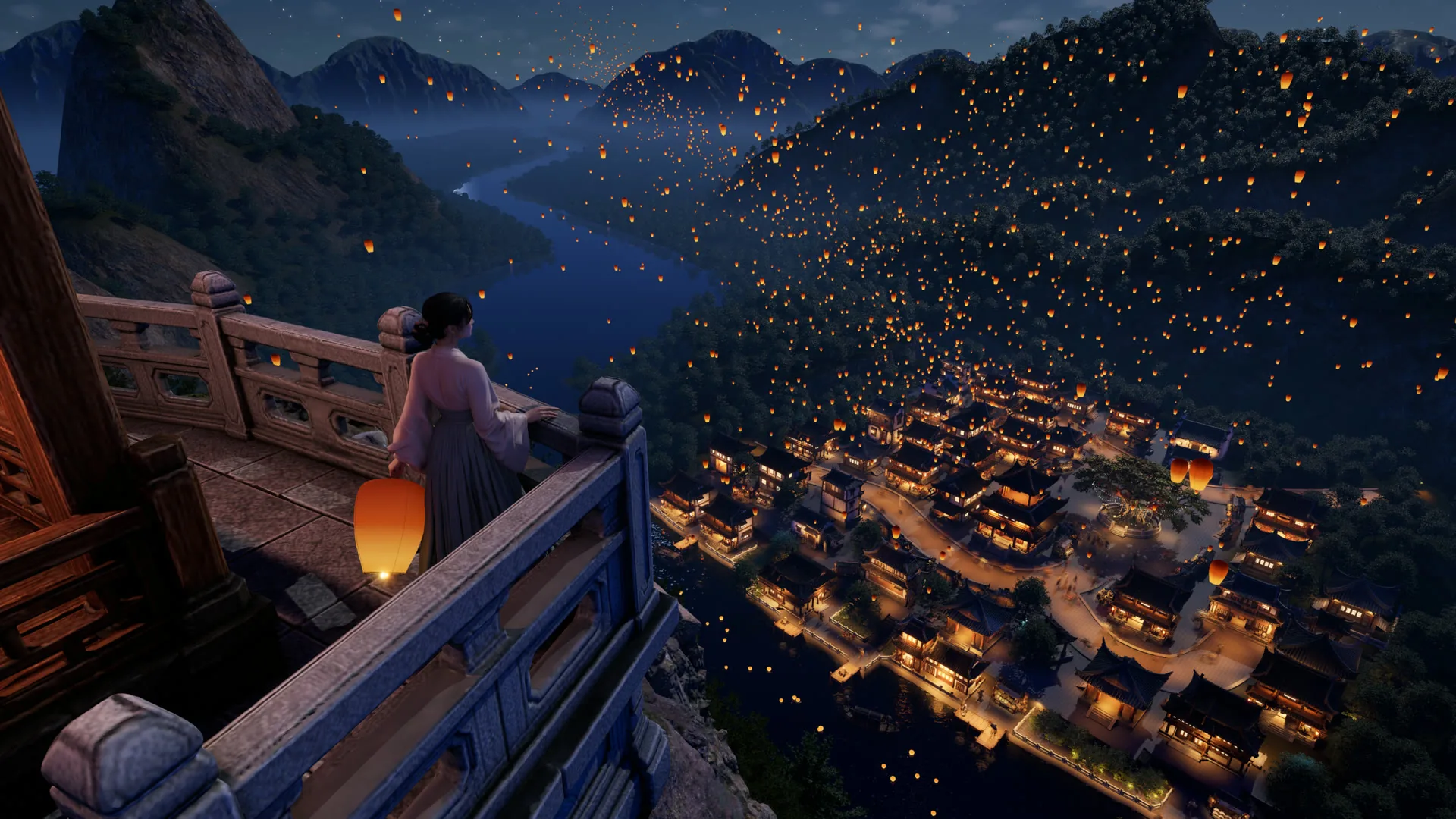
Inspired by the closing lines of Xin Qiji’s poem, Where the Lanterns Dim asks: can a space make someone feel alone in the middle of a celebration?
Light and motion gather in the town; a lone figure and lantern occupy the cliffside pavilion. Seen from the pavilion, the festival feels close enough to watch, too far to join.
What I built
- World layout, terrain sculpting and river system
- Set dressing and composition of the town and pavilion
- Day and Lantern Festival night lighting
- Atmosphere: fog, sky and post-processing
- Sky lantern system in Niagara
The Crowd
“Fine steeds and carved cabs spread fragrance en route … while fish and dragon lanterns dance all night.”
Clustered light, dense street life and constant motion create the festival’s sense of abundance.
Iterations
Establishing a spatial hierarchy
Camera framing differs between versions.
- Problem
- The buildings formed a uniform field, without clear streets or a center.
- Change
- I divided the town into blocks, defined the waterfront, and opened a central square.
01Before
An undifferentiated layout 02After
Streets, square and focal center
Technical implementation
- 01
Shoreline and houses
Terrain and river data define one bank spline for the walls, platforms, piers and railing. Shared frames keep their offsets aligned, while editable spacing and pier exclusions preserve access gaps. Houses sit back from this generated edge.
Live parameter edits · Shoreline PCG 01Find the bank
Split terrain by river elevation, isolate the nearest dry bank, then sort the points into a spline.
02Share the bank frame
Sample shared joints and resolve a consistent river side. The opposite sign drives landward platform offsets.
03Leave room for piers
Place piers at editable intervals and omit selected indices. Measure railing clearance in XY to leave access gaps.
- 02
Crowd
- Problem
- With random-walk agents, people kept converging on the shortest paths through the town. Busy lines formed while the squares stayed empty.
- Decision
- I added destinations the agents are drawn to, such as the banyan square, stalls and the docks, and placed static groups where the walkers never went.
- Result
- The crowd spreads through the streets and is densest at the square, which is also the brightest point of the frame.
- 03
Town edge blending
- Problem
- Where the town met the landscape, building bases and paving cut hard lines into the terrain.
- Decision
- I used a runtime virtual texture (RVT) so the landscape colour bleeds into the meshes at their base, with extra grass and debris along the seam.
- Result
- The town sits in the valley instead of on top of it.
Where the Lanterns Dim
“I find her there where lantern light is dimly shed.”
Open space and restrained lantern light make the pavilion a quiet place to pause and look back.
Iterations
A quieter light at the pavilion
Framing and sky conditions differ between versions.
- Problem
- Broad fill lit the pavilion too evenly, flattening its depth.
- Change
- I used restrained rim lighting and localized warm light, letting larger surfaces fall into shadow.
01Before
Broad fill flattens the pavilion 02After
Restrained light against the blue night
Technical implementation
- 01
Water
I adapted UE’s Water material for the valley view, tuning near and distant normals, slowing the river flowmap, and adjusting scattering, absorption and surface reflectance.
Daylight Lantern Festival night Material flow
The upper groups cover surface detail and river flow. The lower group controls the water’s optical appearance.
01Surface detail
Camera depth blends the normal layers. I adjusted their scale and strength for the distant pavilion view.
Near: scale 420, strength 0.30. Distant: scale 2200, strengths 0.22 / 0.16.
02River flow
The enabled river branch uses a slower flowmap. Normal flatness controls the river-specific normal treatment.
Flowmap speed: 0.002 → 0.0015. Normal flatness: 0.5 → 0.4.
03Water appearance
Scattering and absorption feed Single Layer Water through coefficient calculations. I also adjusted roughness and specular response in the material instance.
Roughness: 0.02 → 0.08. Specular: 0.225 → 0.255. Absorption values are coefficient controls, not display RGB colours.
MI_River_Realistic 16 parameter overrides
MI_River_Realistic → Water_Material_River → Water_Material_Inst → Water_Material
River and Water VS Mapping are enabled. Waves off · Ocean Foam off · Caustics off. These switch values include inherited settings.
Parent values are inherited from Water_Material_River. Vector values use RGBA order. Parameter Parent MI_River_Realistic Water Roughness 0.02 0.08 Water Specular 0.225 0.255 Water Fresnel Roughness 0.1 0.1 Water Fresnel Specular 0.225 0.255 Default Near Water Scale 512 420 Default Near Normal Strength 0.25 0.3 Default Distant Water Scale 3500 2200 Default Distant Normal Strength 0.3 0.22 Default Distant Normal StrengthB 0.25 0.16 River Normal Flatness 0.5 0.4 River Flowmap Speed 0.002 0.0015 Foam Opacity 1 0.35 Foam Roughness 0.4 0.65 Absorption (0, 24.9032, 350, 8) (180, 280, 220, 3.5) Scattering (1, 1, 1, 0.5) (0.34, 0.4, 0.36, 0.5) Foam Emissive (0.287441, 1, 0.187821, 1) (0, 0, 0, 1) - 02
Forest PCG
Surface sampling and layered noise build the forest distribution. Exclusion zones, slope and world-space limits control placement, then a two-stage random split assigns three Hornbeam variants before spawning.
Forest distribution · live parameter adjustments Forest distribution
Sample the landscape → constrain placement → assign and spawn tree variants.
01Sampling and density
Surface sampling establishes the forest coverage. Density noise, position jitter and spatial noise break up the pattern; normals then drive a density filter on the slopes.
Exposed controls: sampling density, looseness, noise ranges and slope limits.
02Placement constraints
Actors tagged ExcludeZone supply bounds to the Difference node. The remaining data is collapsed to points, given varied transforms, and filtered by minimum world Z and Y coordinates.
Exposed controls: scale range, MinimumTreeWorldZ and MinimumTreeWorldY.
03Tree variants and spawning
The first random choice takes 60% for A. A second choice takes 75% of the remainder for B, leaving C. Each branch writes a Hornbeam mesh to the Mesh attribute before the branches merge and feed the spawner.
Target mix: A 60% / B 30% / C 10%. Output node: Skinned Mesh Spawner.
The Glance Back
“When all at once I turn my head …”
Distance, light and scale invite a second look, from the festival to the lone figure nearby.
Composing the glance back
This study is built around a fixed overlook. The viewer shares the pavilion’s position: close to the figure, looking across the valley at a celebration beyond reach.
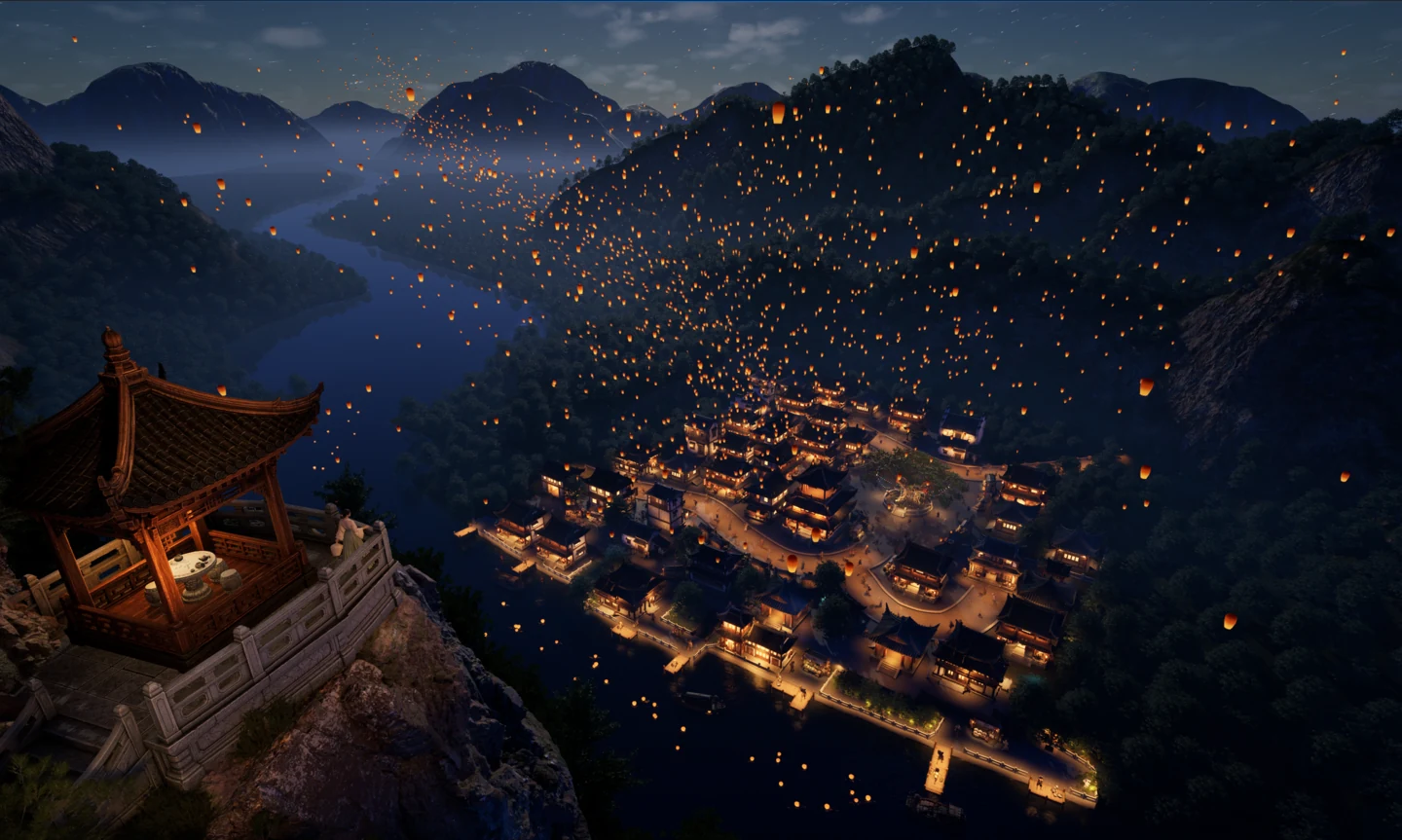 FestivitySolitudea second look
A distant first draw
Concentrated warm light and dense buildings make the town the intended first focus. Its distance keeps the viewer outside the gathering.
A place to look from
The large foreground pavilion establishes the viewer’s position. Its sparse occupation gives solitude a physical relationship to the crowd below.
A quieter discovery
The figure sits at the balustrade between the pavilion and the valley. A small silhouette is intended to reward a second look without competing with the town.
One shared night
Lanterns carry the town’s warm color into the sky. Repeating that warmth near the pavilion connects the two places despite their separation.
- A distant first drawConcentrated warm light makes the distant festival the intended first focus.
- A place to look fromThe foreground pavilion places the viewer outside the celebration, looking in.
- A quieter discoveryA less prominent figure leaves room for discovery on a second look.
- One shared nightRepeated lantern warmth connects two places separated by distance.
Technical implementation
- 01
Atmosphere and time of day
I used SunMoonDaySequence to carry the same overlook through a full day, tuning skylight, cloud coverage and height fog across the cycle. A secondary fog-card layer adds local depth around dawn.
SunMoonDaySequence 24 hours · 30 seconds · 2× playback · fixed camera Fog Cards A secondary dawn layer
Nine fog cards add a local layer between 05:00 and 09:30, with full strength from 06:00 to 07:15. Their contribution recedes as the daylight scene clears.
FogStrength - 02
Sky lanterns in Niagara
I organize the lanterns by viewing distance: preserve the construction of a single lantern up close, then let silhouette, warm light and movement carry the Niagara field across the valley.
LOD 0 · Close-up
The individual lantern
Paper seams, a bamboo rim and a suspended fuel cell remain visible up close; warm light glows through the paper.

Loading the lantern…
Drag to orbit · Use + / − to zoom
LOD 1–2 · Mid & distant layers
From one lantern to a sky full of light
Across the valley, silhouette, warm light and movement carry the effect. Niagara separates the lantern field into mid and distant layers; the demonstration moves from the emitter setup to the moving particle field.
Niagara · Emitter setup and lantern field
Reflection
What the frame establishes
The final composition brings the pavilion close and holds the festival at a distance. Both share warm light, but differ in scale and density. That spatial contrast carries the idea of being near a celebration while remaining apart from it.
What I learned
- Fixing the camera on day one was the most useful decision in the project. Every question about detail, density or light had a clear test: does it change this frame?
- Cutting the dynamic foliage taught me to spend effort where the player can see it. Ambition that the camera cannot show is cost without return.
Next time
- The intended viewing order is still a design hypothesis. Show the unannotated frame to viewers unfamiliar with the project and ask what they notice first, whether they find the figure, and how they read the relationship between the two places.
- Capture before and after screenshots at every milestone instead of reconstructing them at the end.
- Give the crowd a proper navigation setup from the start rather than fixing random walks afterwards.
- Make the scene walkable, so the move from the town to the pavilion can be played rather than only watched.